Chapter 7 of 8
7 min read
What 30 Articles Actually Does for Your Coaching Business
Most coaches publish 10 blog posts, check their rankings after a few months, and decide SEO does not work. The answer to how many blog posts for seo isn't what most expect.
You need 30 to 40 published articles before search engines treat your site as a real authority. That is the pattern across every client I have worked with.
Key Takeaways:
- Search engines need 30+ articles to recognize topical authority in your niche
- Internal links between articles create the web that makes rankings compound
- Most coaches quit at 10 posts, right before SEO traction begins
- Articles you publish today keep generating traffic for years
Why Do You Need 30 Articles Before SEO Starts Working?
Search engines require a critical mass of relevant, connected content before treating your site as an authority on any topic. Five blog posts aren't enough for search engines to understand what your coaching business covers.
Thirty articles, connected by internal links and organized around core topics, give search engines the signals needed to rank your pages for competitive queries in search engine results.
1. The Growth Curve From 5 to 50 Articles
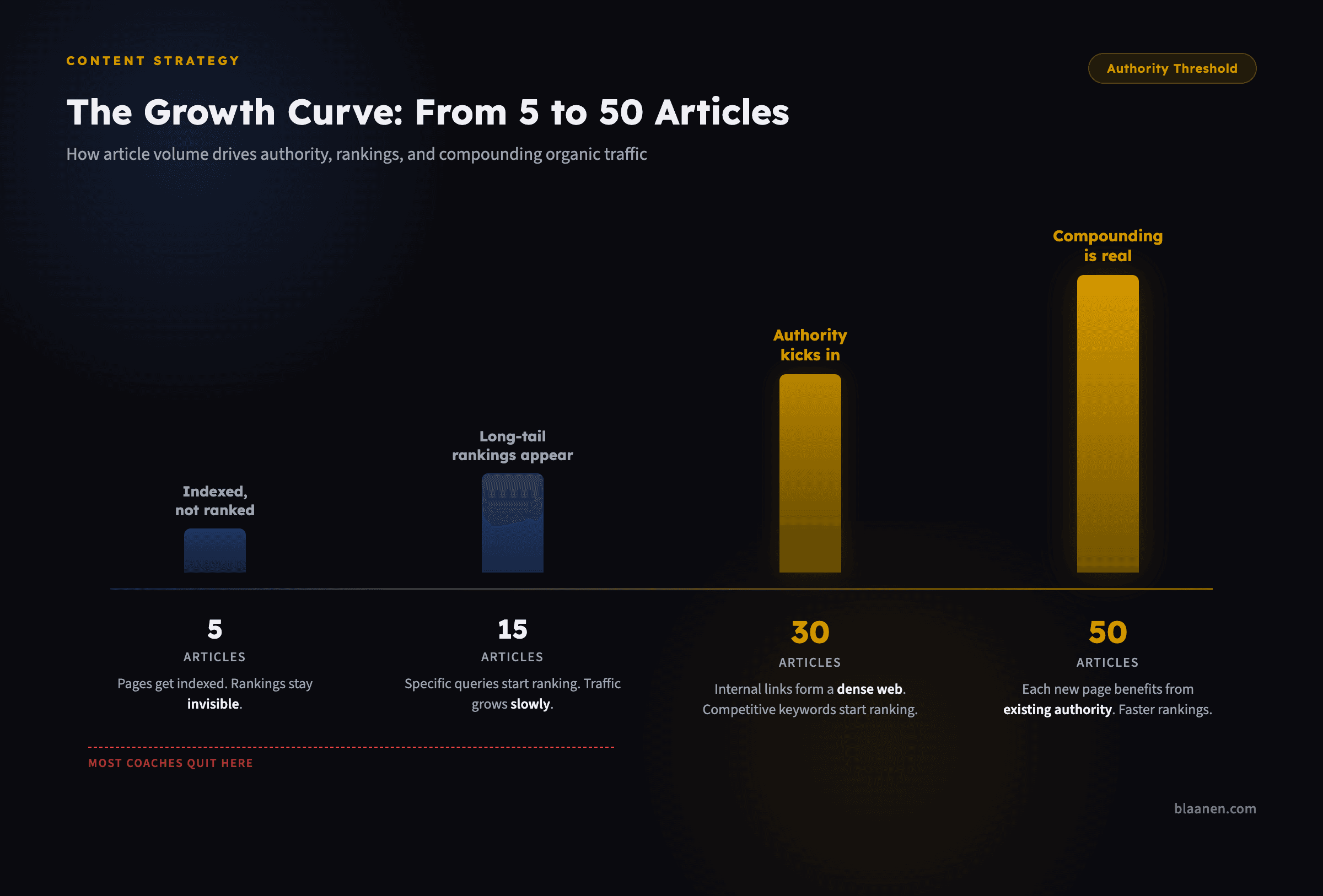
At 5 articles, your pages get indexed but SEO rankings stay invisible. Search engines have seen your site, but have no reason to trust it yet.
At 15 articles, long tail search rankings appear. Users find your pages through specific questions you answer well. Traffic grows, but slowly.
At 30 articles, authority kicks in. Internal links form a dense web. Search engines understand the relationships between your pages. Your site starts ranking for broader, more competitive keywords in search results.
At 50 articles, compounding is real. Each new page you publish benefits from the authority your existing content has built. Users find your pages through organic search more frequently. Higher rankings arrive faster with each article because the links between your pages carry more weight.
2. What Search Engines Need to See
Search engines evaluate your site as a whole, not page by page. The algorithm looks for clusters of related content connected by links that match search intent.
When you publish 30 articles about coaching, leadership, and your methodology, search engines recognize a pattern. Your pages become the answer for more queries because they demonstrate depth across the topic.
A single page can't signal expertise. A web of 30+ pages, linked together with purpose, tells search engines this site knows its subject.
Does Word Count Matter More Than Article Count?
Word count isn't a ranking factor by itself, but content length directly influences how well search engines understand your page. Longer articles naturally contain more context, more related keyphrases, and more answers to what users are searching for.
The real question isn't how many words per article. It's whether each article matches the search intent behind the query users type into search engines.
When Content Length Helps SEO Rankings
Pages with low word count often fail in search results. Search engines aim to understand what a page covers and whether it satisfies user intent. Thin content with minimal word count gives them nothing to evaluate.
Content depth matters more than content length. A 2,000 word article that answers the user's question thoroughly outranks a 3,000 word page stuffed with filler. High quality content matching user intent is what search engines reward, not raw word count alone.
Search engine optimization is about relevance. Adding more words without adding depth doesn't help. Content that's too long without structure leads to poor experience for users, which hurts SEO rankings.
The Right Word Count for Coaching Blogs
I have seen coaches obsess over hitting 3,000 words when 1,500 words of genuine depth outranks it every time. Word count follows from covering the topic thoroughly, not from padding.
For most coaching blog posts, 1,200 to 2,500 words provides enough depth without losing users. Your content quality matters more than hitting an exact word count target.
The goal: answer each search intent completely, structure the page for readability, and publish. More content on a page only helps when it adds more value for users reading it. Word count follows naturally when you cover the topic with real depth.
How Do Internal Links Build Your Site's Authority?
Internal links are the connective tissue that helps Google understand your site's structure and gives users a path to discover related content. Without strong internal linking, even 50 articles sit as disconnected pages that search engines struggle to evaluate. Internal links pass relevance and authority signals between your pages, building authority across your entire site.
The Hub and Spoke Model
A pillar page on your core topic links out to supporting articles. Each supporting article links back and to related cluster articles. This creates content clusters that signal expertise to Google.
Strong internal linking enhances SEO performance for your cornerstone content. The more relevant links a page receives, the more important Google considers it. At 30 articles, the linking web reaches the density that makes this work.
Why 30 Articles Creates Linking Density
With 5 articles, each page can link to 4 others. The network is thin. With 30 articles organized into 3 to 5 content clusters, each page connects to 8 to 12 relevant pages.
Users navigate naturally between related topics. Fixing broken links and building new connections between pages improves how search engines crawl and rank your content. Internal links are one of the easiest wins in SEO, and most coaching sites completely neglect them. Every article you add creates new opportunities for links that strengthen the whole network.
What Does the SEO Timeline Look Like for Coaches?
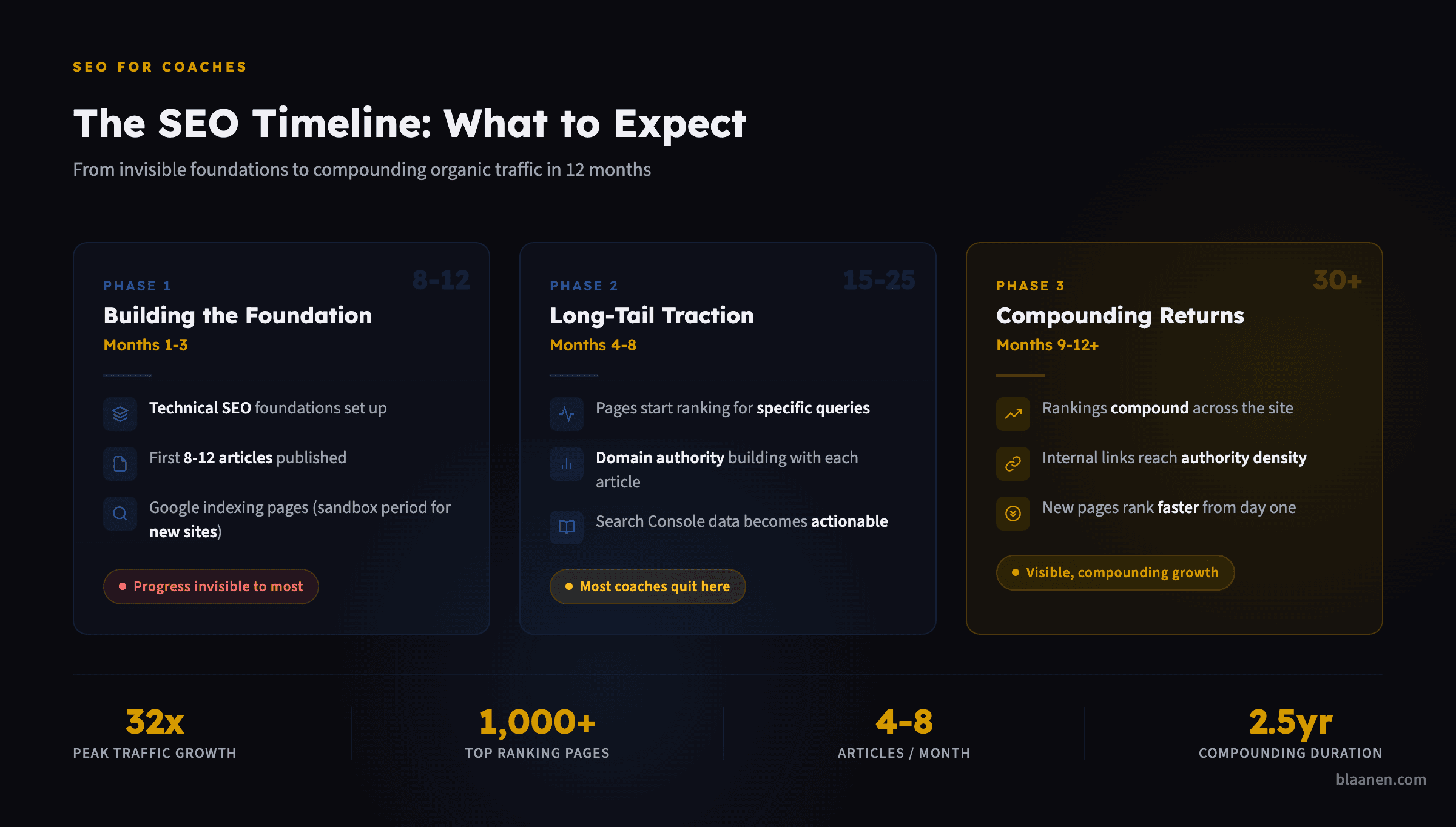
Most coaching businesses see SEO traction within 4 to 12 months, depending on domain authority, content quality, and competitive landscape. The seo timeline varies, but the pattern stays consistent. SEO is a long term strategy requiring effort over months. It doesn't happen overnight, and anyone promising faster seo results without context isn't being honest.
1. Months 1 to 3: Building the Foundation
The first phase focuses on technical seo foundations, brand brain extraction, and initial content production. For new websites, Google may take 1 to 3 months to fully index your pages. New websites experience what is called the sandbox period.
During this phase, you publish your first 8 to 12 articles. You set up Google Search Console and your Google Business Profile. Page speed gets addressed. Your seo strategy takes shape as keyword research identifies high value topics. Technical seo issues like backlink building, page titles, and site structure get addressed early.
SEO progress during this phase is invisible to most website owners. Technical seo foundations matter here because search engines cannot rank what they cannot crawl. Trust the process. Search engines are watching, indexing, and evaluating.
2. Months 4 to 8: Long Tail Traction
Blogs start ranking for specific queries. Search results show your pages for questions users ask about your expertise. Domain authority builds as more content gets indexed and earns high quality backlinks from other sites that find real value in what you publish.
Google Search Console data becomes actionable. You see which pages rank, which queries drive impressions, and where to focus your seo strategy next. SEO tools confirm your seo progress.
This is where most coaches quit. Rankings are growing but numbers feel small. SEO success at this stage looks like a beginning, not the middle. Stick with it. The blog content you publish now is building the foundation Google needs to reward your site with higher visibility.
3. Months 9 to 12+: Compounding Returns
This is where seo success becomes visible. Rankings compound. Each article benefits from the authority built across your site. Organic traffic grows faster with each new page.
O-Care achieved 32x peak traffic growth over a sustained seo timeline, climbing from 5 to over 1,000 top ranking pages in search results (Source: Ahrefs, 2025). That kind of compounding does not come from one viral post. It comes from publishing optimized content month after month until the site reaches authority density. The internal links between those pages kept building authority signals long after each article went live.
Another client saw 4.4x traffic growth following the same pattern (full ROI case studies).
The coaches who reach 30 articles and stay consistent are the ones who see these results. Top ranking pages belong to businesses that invested in more content over months, not days. The seo timeline rewards patience. Every month you publish quality articles, Google has more evidence that your site deserves to rank.
I think the hardest part is not the work itself. It is trusting that the work will pay off before the numbers prove it. I have seen this enough times to know: the coaches who stay the course are the ones whose sites become the go-to resource in their niche.
What Happens When Coaches Quit at 10 Articles?
Most coaches who say SEO does not work stopped before reaching the threshold where Google rewards consistency with higher rankings. Ten articles is not enough for search engines to build a clear picture of your expertise. Rankings stay flat. Pages rank for a handful of low competition queries. The compounding effect never kicks in.
The Picky Client Pattern
I have worked with coaches and consultants who have decades of phenomenal experience but were so protective of their content that nothing got published. They wanted every blog to be perfect before going live.
The problem: you need 30 to 40 published posts to build the web of optimized content that signals authority to Google and AI. If you don't allow content to be published, iterated, and improved, the seo work stalls.
The brand brain process captures everything upfront so coaches trust the content enough to let it publish (how it works). The result is high quality content that sounds like you, not seo friendly content that sounds generic. That steady commitment is what leads to long term success in search.
Can You Publish Too Much Content?
There's no rule about a maximum number of articles, but publishing low quality content hurts your SEO more than publishing nothing. The goal is not to create content at maximum speed.
It's to publish optimized content at a pace you can sustain while ensuring each article provides valuable content for your readers. Search engines reward a consistent content strategy over random bursts of activity.
A sustainable pace for coaching businesses is 4 to 8 blogs per month. That builds momentum without sacrificing quality. Each piece should answer a search intent your ideal clients have and provide more value than what already ranks on page one.
Two well researched, voice aligned articles outperform five rushed blogs. Website owners who publish too much content often end up with thin content that tanks rankings. More content only helps when each page earns its place by answering what people search for with quality and depth.
The coaches I work with publish 4 to 8 articles per month. That pace gives Google consistent signals without burning through your topic map too fast. It also leaves room for the links between articles to develop naturally as you cover more ground.
What Happens After You Stop Publishing?
Articles you publish keep working long after you stop producing them, which makes SEO fundamentally different from ads or social media. When you stop paying for ads, traffic stops. When you stop posting on social, engagement drops. Organic search traffic from published articles continues because those pages still rank.
Yup Technologies built 180 pages that compounded for 2.5 years with zero refreshes, achieving 26x traffic growth (Source: Ahrefs, 2025). Another site still drives 5x the traffic it had before the engagement, even 1.5 years after active production stopped (more ROI proof).
Every article is an asset, not an expense. It builds brand visibility. It earns rankings. It brings users to your pages while you sleep.
The content moat you build by reaching 30+ articles creates sustainable growth that competitors cannot quickly replicate. Links between your articles keep passing authority. Users keep discovering related pages. That is the seo success that makes this work worth the investment.
Content refreshes and new articles keep your rankings competitive. But the foundation of optimized content keeps delivering seo results even during quieter months. That is a level of durability most channels cannot offer. Users keep finding your pages, links keep passing authority, and your site keeps earning traffic without additional spend.
The 30 Article Threshold Is Where SEO Math Starts Working
Thirty articles isn't a magic number. It's the point where internal links reach density, where search engines see authority, and where rankings compound. Most coaches never get there because they stop too early.
If you're considering SEO for your coaching business, it takes consistent effort over 6 to 12 months. The results are worth it if you commit. See how the process works, or reach out directly to start with the brand brain process.
Your expertise deserves to be found by the people searching for it. The ROI of reaching that threshold keeps compounding long after you publish.
Ready to explore what this looks like for your business?