Chapter 3 of 8
13 min read
The Compounding Math: What SEO Actually Returns
Most SEO ROI calculators use "traffic value" as the metric. That number means nothing to a coaching business selling $10K packages through discovery calls.
The real calculation starts from four numbers every coach knows: package price, leads per article, close rate, and content lifespan. When you run that math with real client data, a single $1,000 article can return $180K over three years. That is not a projection. It is what happens when search engine optimization compounds.
Key Takeaways:
- A single article generating 2 leads/month at a $10K package and 25% close rate produces $5,000/month in revenue
- SEO content compounds for 2 to 5 years after publication, unlike paid ads that stop when spending stops
- Real client results: 5x traffic (Rebecca Campbell), 26x traffic (Yup), 32x traffic (O-Care)
- Most coaches need 30 to 40 published articles before meaningful traction begins
Why Do Most SEO ROI Calculations Get It Wrong for Coaches?
Most SEO ROI tools estimate "traffic value" by multiplying visitors by equivalent ad cost per click. For a coaching business selling high-ticket packages through discovery calls, that number tells you nothing about actual revenue from search engines.
1. The Traffic Value Trap
Tools like Ahrefs calculate traffic value as a dollar estimate. They take your monthly visitors and multiply by what those clicks would cost as paid ads on Google.
That works for e-commerce. A click worth $2 that converts at 3% on a $50 product gives you usable data.
For a life coach or business coach selling $5K to $25K packages, the math breaks. One coaching client from organic search could be worth more than 10,000 pageviews on an e-commerce site.
Traffic value also ignores the search results page itself. A page ranking position 3 for a high-intent keyword like "executive coaching for tech founders" generates different leads than position 3 for "what is life coaching."
The digital marketing industry defaults to this metric because it works for most businesses. Coaching is not most businesses.
2. The Right Formula for a Coaching Practice
The correct seo roi for coaches calculation uses the client's actual business numbers, not estimated ad spend equivalence.
Here is the formula: Package Price x Leads Per Article x Close Rate x Content Lifespan = Actual ROI.
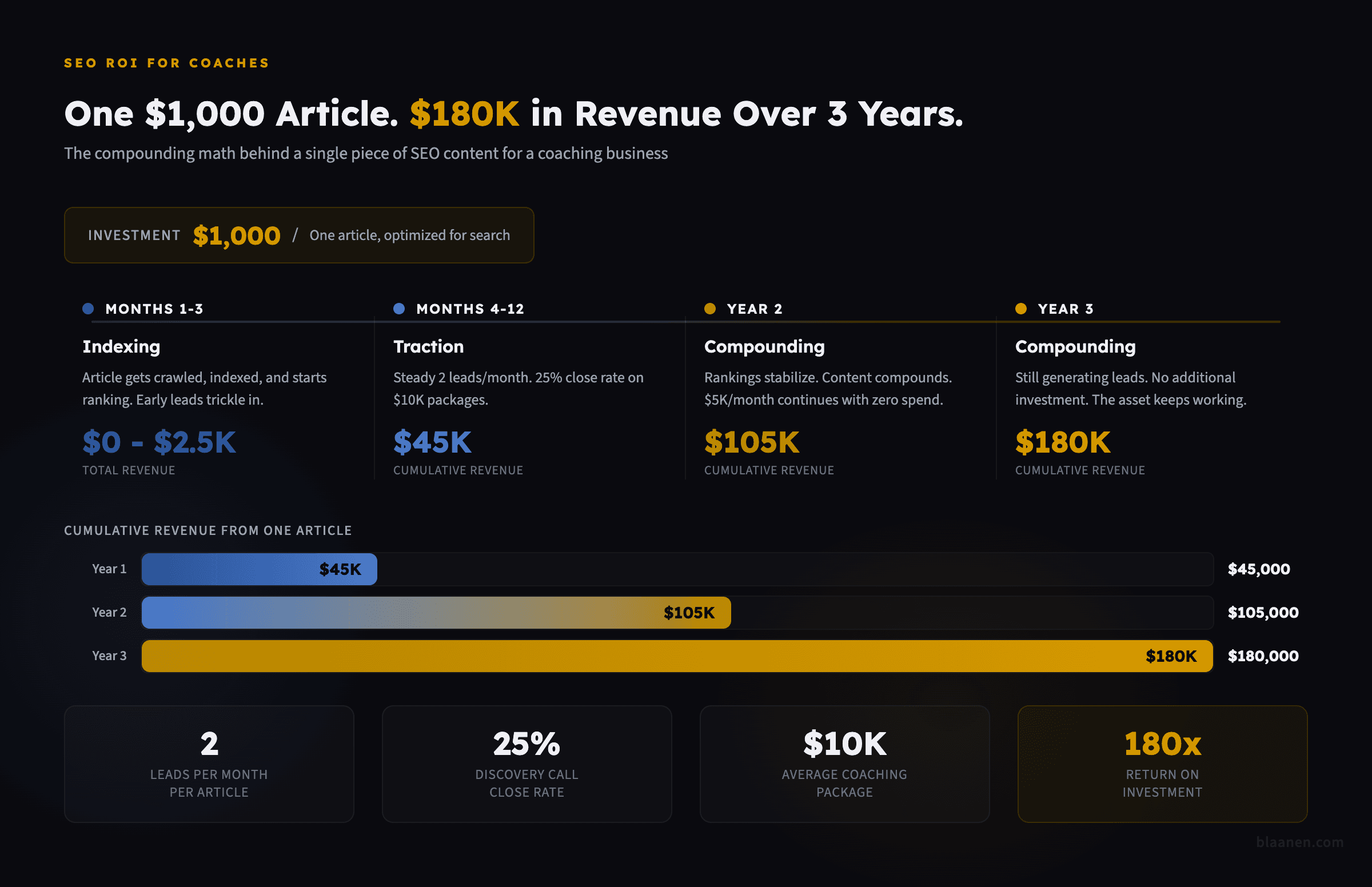
A $10K coaching package with 2 qualified leads per month and a 25% close rate means one article generates $5,000 in monthly revenue.
Compare that to $1,000 in paid ads. Those ads generate leads only while you keep paying. Stop the spend, stop the leads.
Seo for coaches works differently. The article keeps ranking. The leads keep arriving. The compounding begins.
What Does the Real ROI Math Look Like for a Coaching Business?
A single well-structured article can generate $5,000 per month in coaching revenue. The calculation uses four numbers every coaching practice already knows. No complicated models required.
1. The Four Variables
Every coaching business can plug in these numbers:
- Package price: What does your coaching engagement cost? Use $10K as a baseline.
- Leads per article per month: How many discovery calls does one ranking article produce? Use 2 as conservative.
- Close rate: What percentage of discovery calls become clients? Use 25%.
- Content lifespan: How long does the article rank and generate traffic? Use 3 years as minimum.
2. Running the Numbers: One Article
Here is how the math works for a single blog post:
| Timeframe | What Happens | Revenue |
|---|---|---|
| Months 1 to 3 | Article gets indexed, starts ranking, generates 0 to 1 leads | $0 to $2,500 |
| Months 4 to 12 | Steady 2 leads/month, 25% close rate | $5,000/month |
| Year 2 | Content compounds, rankings stabilize | $60,000/year |
| Year 3 | Still generating leads with zero additional investment | $60,000/year |
Total 3-year return from one $1,000 article: approximately $165,000 to $180,000.
That is not a theoretical number. It is the structural reality of how Google rewards content that ranks.
3. Why the Numbers Get Better Over Time
A life coach publishing two articles per month invests $2,000 in content. After six months, twelve articles sit in the index. Some rank immediately. Others need time.
By month 12, the early articles are generating steady leads while the newer ones climb. The investment stays flat at $2,000/month, but cumulative output keeps growing. By year two, the life coach has 24 articles generating leads without any additional spend on the earlier pieces.
This is the math that separates SEO from every other channel. Advertising requires continuous spend. Social media posts disappear from feeds within hours. Blog posts built for search engines keep working.
4. The Portfolio Effect
Not every article converts equally. Some generate 5 leads per month. Others generate zero.
The compounding effect accelerates once you reach approximately 30 published articles. That is the threshold where topical authority, internal linking, and entity signals reach critical mass (the full growth curve).
Top performers carry bottom performers. A career coach publishes content on leadership transitions, team dynamics, and executive presence. Each article reinforces the others in the eyes of search engines and AI systems. When ideal clients search for related topics and keep landing on the same site, trust builds.
How Does SEO Compare to Paid Ads for a Coaching Business?
Paid ads deliver leads while you pay. SEO content delivers leads for years after the initial investment. For a coaching business where packages start at $5K or more, the compounding difference is what separates sustainable growth from a constant spending treadmill.
1. The Cost Curve: Ads vs. Content
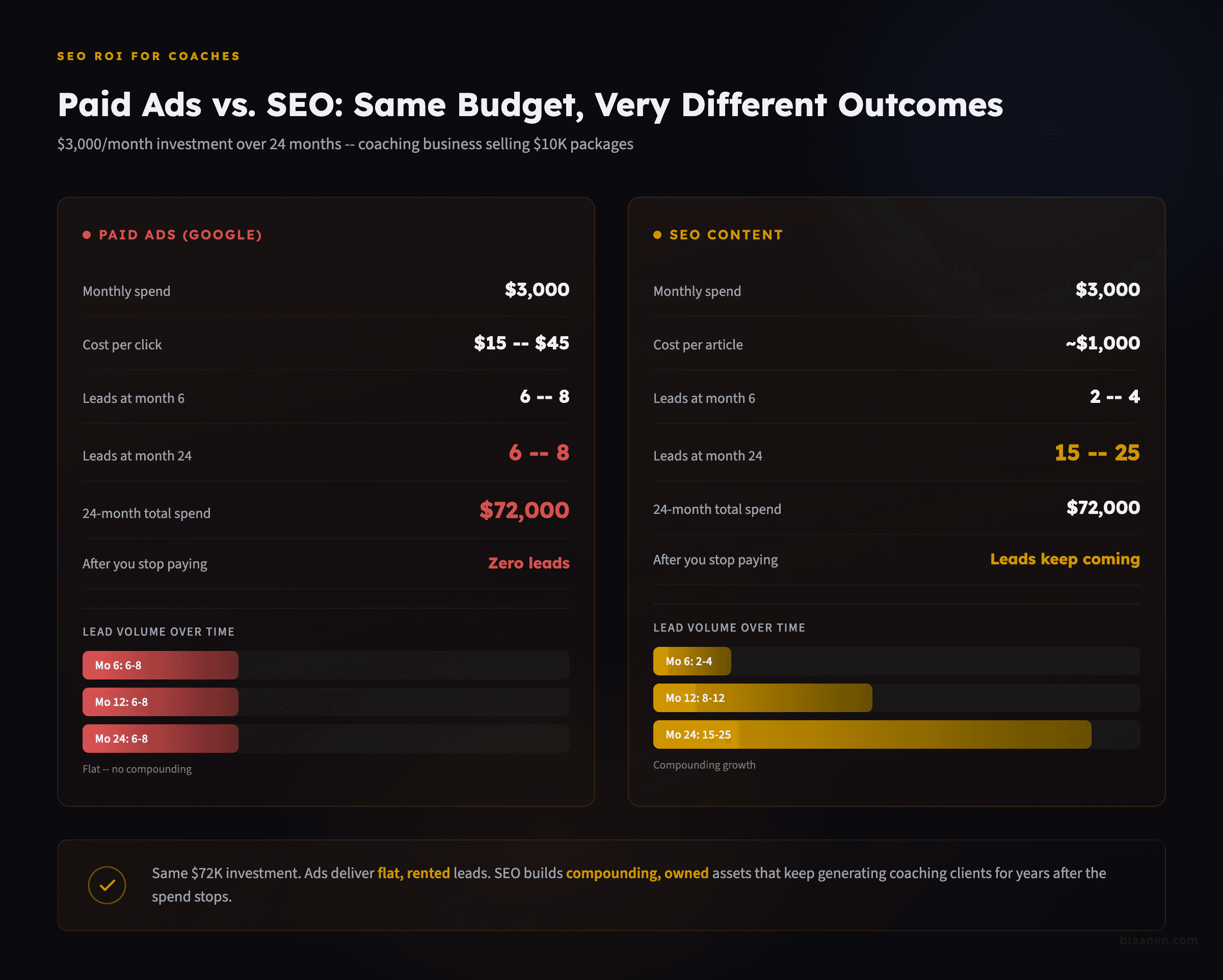
Google Ads for coaching keywords typically costs $15 to $45 per click. One hundred clicks means $1,500 to $4,500 spent for maybe 2 to 3 leads.
That same $3,000 invested in SEO content produces an article that works for 3 or more years.
| Channel | Monthly Spend | Leads at Month 6 | Leads at Month 24 | Total Investment (24 mo) |
|---|---|---|---|---|
| Paid ads | $3,000 | 6 to 8 | 6 to 8 (spend continues) | $72,000 |
| Seo for coaches | $3,000 | 2 to 4 (building) | 15 to 25 (compounding) | $72,000 |
After 24 months, the paid ads stop producing the moment you stop spending. The SEO content keeps generating leads from search results with no additional cost.
A life coach spending $3,000/month on Google Ads needs to keep spending $3,000 every single month. After two years, they have spent $72,000 and own nothing. The same amount invested in SEO produces assets that keep generating coaching clients for years.
The compounding gap widens over time. At month 36, the paid ads coach has spent $108,000 and still needs next month's budget. The SEO coach stopped active investment a year ago and the content is still producing leads.
2. Why Ads Still Have a Role
I am not against advertising for coaches. Ads work faster when you understand your audience and your messaging.
Testing messaging with paid ads before building long form content around those topics is a smart seo strategy. The brand brain process I use helps coaches understand their audience deeply, which benefits both channels.
Social media marketing and social media posts also have their place. They keep you visible. They build relationships. They just do not compound the way search engine optimization does.
3. The Trust Factor
Search sits at position two in the Trust Hierarchy, the only scalable channel that builds real trust (see why that matters).
When a potential coaching client finds a business coach through a search engine and reads three articles, that coach has earned credibility through demonstrated expertise. No ad can replicate that signal. Referrals are the highest trust signal but they do not scale. Search discovery does.
What Do Real Client Results Show About SEO Compounding?
Client data across multiple engagements shows the same pattern: slow start, then compounding growth. The numbers are from actual Google Analytics and Google Search Console data, not projections.
1. Rebecca Campbell: 5x Traffic Growth
Rebecca Campbell is a bestselling author with a coaching practice focused on spiritual leadership.
- 5x traffic growth: 3,700 to 18,000 monthly website visitors
- 80% more top-3 search results positions
- Content still driving 2.7x traffic 1.5 years after active work stopped
That last point matters. The content kept compounding even without new articles being published. High quality content, properly structured for search engines, does not expire when you stop paying for it.
2. Yup Technologies: 26x Traffic Growth
Yup is the clearest proof of the compounding principle. One hundred eighty pages of blog posts generated 26x traffic growth, compounding for 2.5 years with zero refreshes.
No updates. No new content. The existing content portfolio kept attracting clients and website visitors month after month. That is what "compounding asset" means in practice.
3. O-Care: 32x Peak Traffic
O-Care demonstrates the principle in e-commerce: 32x peak traffic growth, from 5 to over 1,000 top-3 search results. Different industry, same compounding math.
4. John Mattone Global: Brief Mention
JMG saw 4.4x organic traffic growth during our engagement. For the full JMG case study, see how AI recommendations work.
These results did not happen through keyword research alone. Each engagement started with a deep understanding of the client's IP, their ideal clients, and how search engines should categorize the site.
The content was built to attract clients who were already searching for those specific coaching services. The compounding math only works when the content speaks to the right audience with the right message. That alignment is what separates random blog posts from revenue-generating assets.
When the seo strategy matches the coach's actual expertise and the audience's actual search behavior, the compounding effect accelerates. Generic content written for search engines alone does not produce these numbers.
How Long Does SEO Take Before a Coaching Business Sees Results?
Most coaching businesses see initial traction between months 3 and 6. Meaningful lead generation typically starts after 30 to 40 published articles build enough topical authority for search engines to treat the site as a credible source in the coaching niche.
1. The Timeline Most Coaches Do Not Hear
Here is the honest timeline for seo for coaches:
- Months 1 to 3: Technical seo foundations, content production begins, minimal organic traffic. Search engines need time to crawl and index new content.
- Months 3 to 6: Early rankings appear, some search results visibility. The coaching website starts showing up for long-tail keywords.
- Months 6 to 12: Compounding begins. Blog posts start ranking for multiple keywords. Leads flow.
- Year 2 and beyond: The content portfolio generates consistent clients without proportional new investment.
2. Why Most Coaches Quit Too Early
You need 30 to 40 published articles before seo for coaches delivers meaningful results. That is not my opinion. It is a pattern I have observed across every coaching practice I have worked with.
Many quit after 10 posts. They check analytics two weeks after publishing, see nothing, and conclude that SEO does not work for their coaching business.
The coaching industry rewards patience. So does search engine optimization. The coaches who stay consistent past the 30-article threshold are the ones who build a real competitive advantage.
3. What Speeds Things Up
Keyword research targeting the right coaching niche accelerates results. A nutrition coach targeting "meal planning for hormone balance" will rank faster than targeting "nutrition coaching."
Creating content from the coach's actual IP (their frameworks, client stories, real methodology) produces content that search engines value because it is original. Google prefers unique content that matches search intent. AI systems also favor content with genuine expertise signals over generic advice articles.
A consistent publishing schedule matters. Four to eight articles per month builds the portfolio faster than one blog post every few weeks. Seo for coaches requires this sustained effort because Google rewards sites that publish regularly.
Technical seo also plays a role. Site speed improvements alone can boost search engine rankings for pages that are already close to page one. When a site loads fast, has clean navigation, and meets Core Web Vitals standards, search engines index and rank content more efficiently.
Fixing broken links removes obstacles that prevent Google from crawling your content properly. A life coach with a clean, fast coaching website gives search engines every reason to rank that content higher.
The coaches who combine consistent publishing with solid technical foundations see results faster. Every month of delay is a month your competitors are building their own content portfolio.
What Makes SEO Content Actually Convert for Coaches?
SEO visitors who find a coaching website through search engines arrive pre-qualified. They searched for a specific problem, read the content, evaluated expertise, and chose to reach out. No nurture sequence required. This is why seo for coaches converts at rates that surprise new clients.
1. The Self-Qualifying Search Path
By the time someone reaches out through search, they have already pre-qualified themselves through their own research (how that works).
Compare that to LinkedIn outreach where you are qualifying one conversation at a time. SEO does it at scale, around the clock, for potential coaching clients who are actively searching for exactly what you offer. These are people with intent, not cold prospects.
A career coach who publishes content about leadership transitions does not need to pitch. The article does the qualifying. The reader arrives already convinced the coach understands their situation.
2. Content That Converts vs. Content That Just Ranks
Every page should convert visitors into discovery calls. That means every blog post needs clear next steps.
Include prominent "Book a Call" buttons on every page. Create content that guides readers from the blog post to a sales page naturally. Service pages should connect directly to the topics your content covers.
Use internal links between website pages to build a path. A life coach writing about burnout recovery should link to their coaching services page. A business coach writing about leadership should link to their executive coaching program.
The seo title and meta descriptions for each page determine whether searchers click. Craft them to convert visitors from search results into readers, and from readers into leads.
The site's layout matters. Clear navigation helps both users and search engines understand what each page offers.
3. The Readiness Requirement
Sending pre-qualified leads into a broken sales process is the most expensive mistake in SEO. Before investing in content, make sure your scheduling, lead capture, and close rate are solid. I cover the full readiness checklist on the readiness assessment page.
What Makes the Strategy Compound?
The compounding math only works when the content is built from the coach's actual IP, not from generic SEO templates. Technical foundations, keyword targeting, and content production all matter. I cover each of those in detail on other pages: how the brand brain captures your voice, why 30 articles is the threshold, and how AI systems decide which experts to cite.
What I focus on here is the principle: every article built from a coach's real frameworks, real client stories, and real methodology compounds differently than generic content. Search engines and AI systems can tell the difference. The ROI math on this page assumes content with genuine expertise signals, not commodity blog posts.
How Do You Track and Measure SEO ROI for a Coaching Practice?
Track seo for coaches ROI using three tools: Google Analytics 4 for conversions, Google Search Console for search performance, and a spreadsheet connecting leads to revenue. The formula: (Revenue from SEO minus Cost of SEO) divided by Cost of SEO times 100.
1. Setting Up Tracking
Google Analytics 4 tracks conversions: discovery call bookings, contact form submissions, and lead magnet downloads from search engines. Set up conversion events for every action that indicates a potential coaching client.
Google Search Console shows which specific pages and keywords drive traffic from search engines. Use it to identify which search results bring coaching clients.
Connect these data sources to understand which blog posts generate which leads. This is where most coaches miss the connection between content and revenue.
Without tracking, a coaching practice has no way to know which articles produce discovery calls. I have seen coaches assume their best content is the piece with the most traffic, when the actual lead generator was a lower-traffic article targeting a more specific keyword. The data tells you what your gut cannot.
2. The ROI Worksheet
A coaching practice can track SEO ROI with this framework:
- Monthly SEO investment: Content production, technical maintenance, tools
- Leads from organic search: Discovery calls and form submissions attributed to search engines
- Close rate: Percentage of leads that become coaching clients
- Average package value: Revenue per new client
- Monthly revenue from SEO: Leads x Close Rate x Package Value
- ROI: (Monthly Revenue minus Monthly Investment) divided by Monthly Investment x 100
Seo important numbers to track: cost per acquisition should stay under 10% of your average package value. A solid foundation of tracking makes the compounding math visible and provable.
3. What Good Numbers Look Like
For most coaches implementing a proper seo strategy, healthy benchmarks include:
- CPA (cost per acquisition): Under $500 for a coaching client acquired through organic search
- Organic traffic growth: 20 to 40% quarter over quarter in year one
- Conversion rate: 1 to 3% of organic visitors booking discovery calls
- Content ROI payback: Each article paying for itself within 6 to 12 months
Compare these to advertising where CPA for coaching services often exceeds $1,000 per lead. SEO provides a competitive advantage by compounding returns over more google searches and more time invested in content.
These numbers give any coaching business a clear picture of whether their seo strategy is working. Track them monthly. The compounding becomes visible by month 6.
Seo for coaches delivers consistent clients when the tracking infrastructure is in place. Without tracking, the math stays invisible and the investment feels like a guess instead of a data-backed decision.
Using GA4 alongside Search Console gives you a complete picture. One shows what happens after the click. The other shows what happens before it. Together, they tell you exactly which content earns its keep.
A career coach who tracks these numbers can see which blog posts about career transitions produce the most discovery calls. A business coach can identify which topics their ideal clients respond to. The data removes guesswork from the seo strategy and makes every content decision measurable.
The Math Points in One Direction
SEO content is a compounding asset for every coaching business willing to invest the time and stay consistent. One article generating 2 leads per month at $10K packages and a 25% close rate produces $5,000 monthly. Over three years, that single piece of content returns $180K from a $1,000 investment.
The client data backs it up. Rebecca Campbell saw 5x traffic growth that kept compounding 1.5 years after the engagement ended. Yup Technologies saw 26x growth across 180 pages with zero refreshes over 2.5 years. The math works when you use real coaching business economics instead of traffic value estimates.
The question is not whether seo for coaches works. The question is whether you are building the content portfolio or letting competitors build theirs first. Every month a competitor publishes content and you do not, they are building a search authority moat that becomes harder to overcome.
I work with coaches who are ready to build this asset. If the numbers on this page make sense for your coaching practice, learn how the process works. If you want to understand the volume threshold first, start with the 30-article threshold. Ready to talk? Reach out directly.
Ready to explore what this looks like for your business?