Chapter 4 of 8
8 min read
What Happens When You Don't Show Up in AI Search
AI tools like ChatGPT, Perplexity, and Google Overviews are answering coaching questions right now. When someone asks "who is the best executive coach for tech founders," AI picks the response from a handful of sources. Your business is either in that response or it is not. SEO has not changed as much as people say. The fundamentals still hold. But the distribution of attention has shifted, and that shift creates a visibility gap that compounds over time. The coaches who understand this structural change are building something their competitors cannot replicate. Here is what that means for your coaching business, and what you can do about it.
Key Takeaways:
- AI search tools answer coaching questions by citing specific experts; if you are not cited, your competitor is
- The zero-click shift is a filter that removes tire-kickers, making remaining traffic more qualified
- Every published piece builds a Content Moat your competitor must outproduce to overcome
- Entity models are sticky: once you are established as the expert, new content gets a head start
- The gap between starting now and starting in 12 months is wider than most coaches realize
What Does AI Visibility Mean for Your Business?
AI visibility is your presence in AI-generated answers when potential clients search for coaching topics. This is different from traditional search ranking. Tools like ChatGPT and Perplexity synthesize answers from multiple sources instead of displaying a list of blue links. Your website either appears in those answers or it does not.
37% of users now start with AI tools before Google (Source: Survey / industry research, 2025). That number keeps growing.
When people search for "best leadership coach for executives" or similar keywords, AI does not show ten blue links. It picks an answer. It names specific experts. It cites specific pages.
The question for your coaching business is straightforward: are you in those answers? If you are not, someone else is building AI visibility in your niche while your pages stay invisible to the search tools your potential clients use every day.
How Does AI Decide Which Experts to Recommend?
AI systems cross-reference multiple sources to build entity models of experts. They focus on content from identifiable authors with consistent messaging, structured data on their website, and topical depth across platforms. Understanding how these systems make ranking decisions is the first step toward learning how to appear in AI search results.
1. Entity Signals and Cross-Platform Presence
AI models cross-reference your site, YouTube videos, press coverage, podcast appearances, and social profiles to build an entity model of who you are. Consistency across platforms is what makes this model stick. Your brand identity must match across every page where your name appears.
Schema.org markup tells Google and AI what your business and services offer in a machine-readable format. Without it, the algorithms have to guess. These signals help explain why some personal brands rank above competitors with more experience.
2. Content Structure That AI Can Actually Read
AI reads content in chunks, not full pages. Each section on your web page must stand alone with clear context, defined concepts, and explicit connections between ideas.
Use clear headings, bullet points, and plain language. These systems prefer content that is well structured and easy to understand. Summarizing each section after the heading helps the algorithms recognize what the page covers.
For example, a coaching website with clear structure on every page gives the algorithms something to extract. A wall of text gives them nothing helpful to cite.
3. Topical Authority Over Isolated Keywords
Building topical authority through semantic relationships beats targeting isolated keywords. Keyword research still matters, but as part of a topical web, not as standalone targets for keyword stuffing.
Long form content that covers a topic from multiple angles signals expertise to search engines and AI. A single blog post about leadership coaching tells the ranking systems almost nothing. Forty blogs covering leadership coaching from every angle tell AI you are the authority. For example, writing about coaching ROI, coaching methodology, and coaching results creates a web of keywords and links that reinforces your ranking for each individual page.
What Is the Zero-Click Shift and Why Does It Help Coaches?
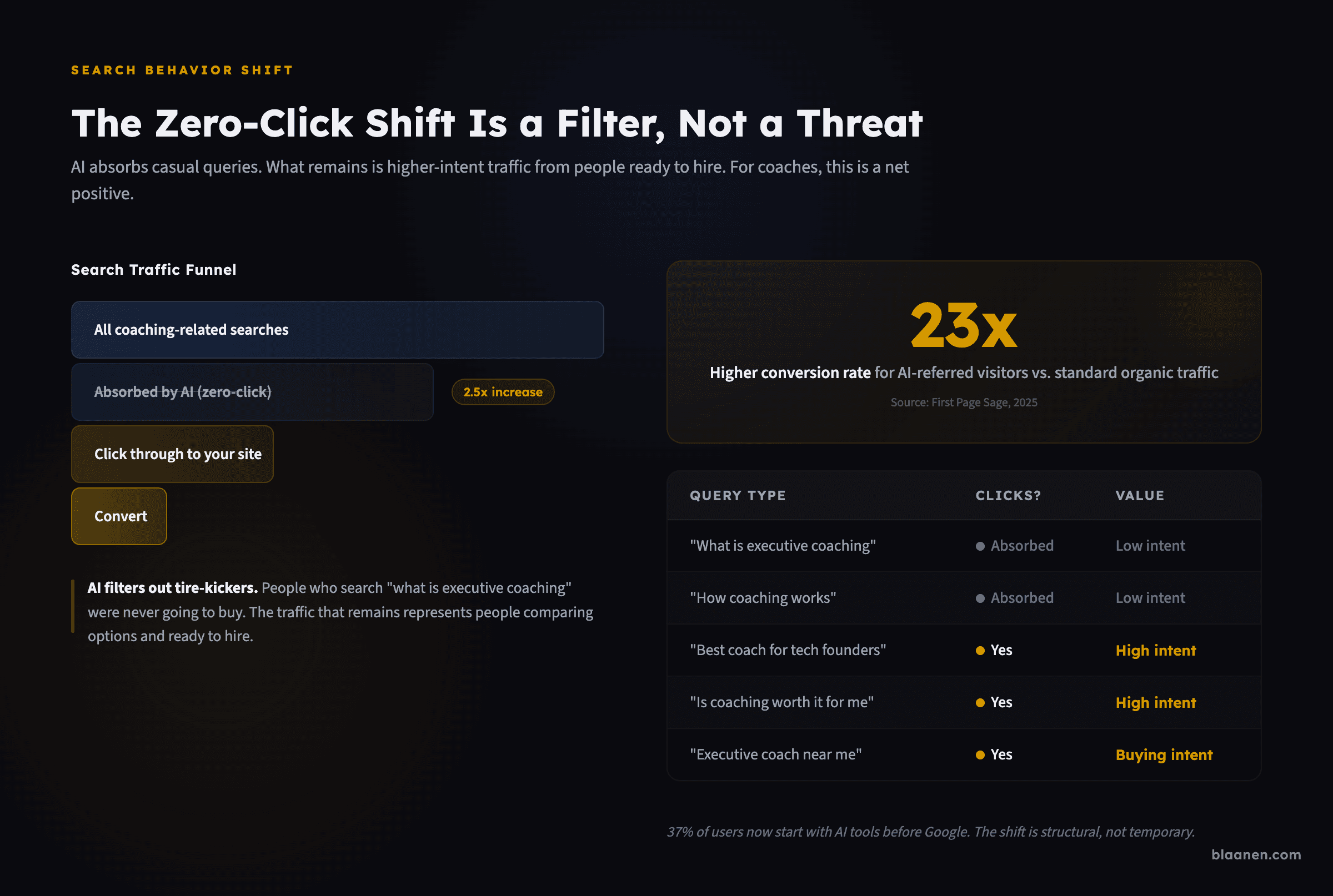
The zero-click shift describes AI answering top-of-funnel questions directly, without users clicking through to a website. For coaches, this is a filter that removes tire-kickers and makes remaining traffic more qualified and helpful. The people who still click through are the ones ready to take action.
AI Overviews absorb informational queries. When someone types "what is executive coaching," AI Overviews often answer that question on the search results page. That traffic disappears.
But here is what most people miss: that traffic was never going to buy coaching services. When people search "what is executive coaching," they are at the beginning of their exploration. They were not ready to hire anyone.
What remains is more valuable. For example, consideration-stage queries like "best executive coach for tech founders" and decision-stage queries like "is coaching worth it for my situation" still generate clicks. AI-referred visitors convert at 23x higher rates than standard organic traffic (Source: First Page Sage, 2025).
Zero-click queries have increased 2.5x in recent years (Source: SparkToro, 2024-2025). The shift is real. But for coaches, it is helpful, not harmful.
This reframing is the most important piece: the zero-click shift is not a threat to your business. It is a filter. The traffic that remains is genuinely helpful for growing your client base, because those users already know what they want. AI tools serve the casual users; your content serves the serious ones.
What Is the Content Moat and How Does It Compound?
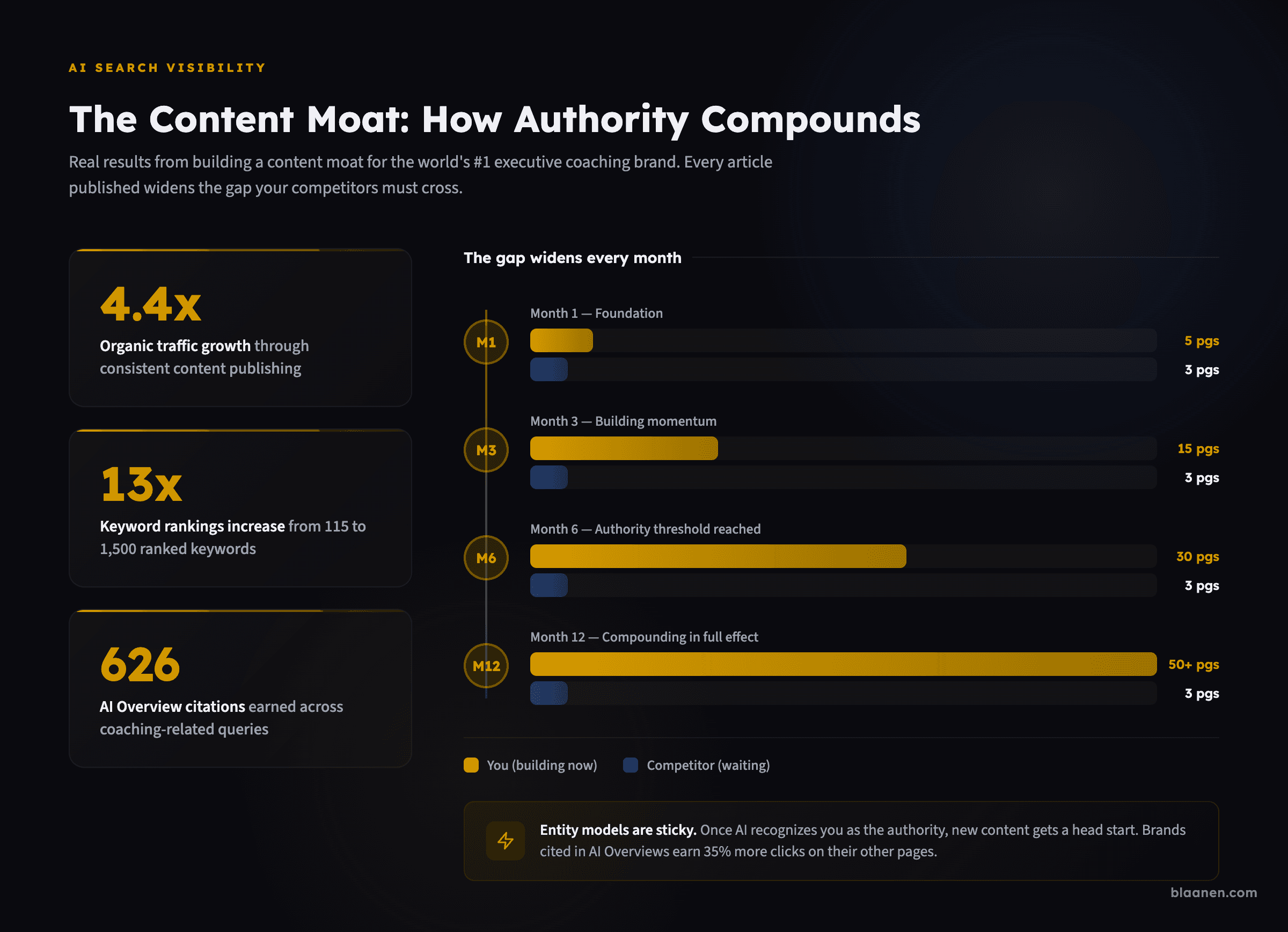
The Content Moat is the competitive reality: every keyword you rank for is one your competitor does not. Authority compounds over time. In this new landscape, entity models are even stickier than traditional ranking positions. A competitor who starts building their content moat today creates a gap that widens every month.
Every piece you publish is a compounding asset, not an expense.
Consider the numbers from a client engagement I ran for the world's #1 executive coaching brand: 4.4x organic traffic growth, 13x keyword rankings increase (from 115 to 1,500), and 626 AI Overview citations earned. That last number matters most on this page. Those 626 citations mean search tools actively recommend that brand when users ask coaching questions. A competitor starting from zero would need years of consistent publishing to match that entity footprint. This example illustrates why the content moat is not a metaphor; it is a measurable advantage.
How Entity Models Make the Moat Stickier
Search engines and AI build persistent models of who is authoritative on a topic. Once established as the go-to source, new articles from that domain get a head start in ranking algorithms. This is partly because these systems train on data patterns that reinforce existing authority signals.
Brands cited in AI Overviews earn 35% more organic clicks on their other pages (Source: Google / SEO research, 2025). Industry benchmark data supports this pattern across multiple verticals. The citation itself drives more visibility, which drives more citations. This is how the content moat compounds.
The Timing Argument
Starting 12 months from now means competing against a competitor who already has published articles, built links, and created blogs that search engines already trust.
This is not a scare tactic. It is the structural reality of how search authority works. The question is not whether to build your content moat. It is when. And the answer is the same for every client I work with: now is better than later.
How Do You Write Content That AI Tools Actually Cite?
Cited content is structured for extraction: clear headings as questions, direct answers in the first paragraph, standalone definitions, and attributed statistics. Writing for citation is not about gaming the system. It is about making your expertise readable to machines without losing what makes it human. Your strategy should optimize each article for both human readers and search engines.
1. Answer Questions Directly
Write your headings as questions your audience asks. Then answer the question in the first 40-60 words of the section. Ranking systems prioritize content that resolves user queries without requiring interpretation.
For example, if you write an article about coaching ROI, the heading should be "What Is the ROI of Executive Coaching?" and the first paragraph should include a specific number and source. Focus on being helpful to your audience first. Write the way your clients think, not the way keywords read.
2. Make Every Section Stand Alone
Each section on your page needs its own context. Define key terms at first mention. AI reads chunks of content, not entire pages.
Add context before every list so the algorithms understand what the items represent. A bulleted list without an introduction is useless to both humans and AI. Write each section as if the reader might land there directly from search results.
3. Add Original Insights and Data
Incorporating unique statistics or proprietary data can increase your chances of being cited by AI tools by 30-40% (Source: Semrush research, 2025). Original data is the single strongest signal for AI citation.
Attribute every statistic with its source. Visible author credentials on your coaching website increase trust for both human visitors and systems scanning your page. This helps explain why expert-written blogs outperform generic content.
Content that repeats what everyone else says gets passed over. Content that adds a perspective the models have not seen before gets cited. For example, clients I work with create articles with their real frameworks, client examples, and proprietary insights in every piece they write.
4. Use Structured Data and Technical Foundations
Use Schema.org markup to define your content explicitly. FAQPage, Person, and similar schemas help Google understand what your web page is about and generate accurate answers.
87% of small business websites lack schema markup (Source: BrightLocal, 2025). This means most coaching websites are invisible to systems that rely on machine-readable data for context. It is a content gaps problem and a technical one.
Schema markup recovers approximately 40% of lost click-through rates from AI Overviews (Source: SEO research / case studies, 2025). The technical work matters as much as the writing.
Check your robots.txt file. If it blocks GPTBot or Google-Extended, crawlers cannot access your training data sources. No access means no citations, regardless of how good your articles are.
What Practical Steps Build AI Visibility?
Building AI visibility requires consistent execution across your site, content strategy, and technical setup. The practical ways to start include publishing long form content regularly, checking for crawler access, and building your brand across multiple platforms. You can optimize each step without overhauling your entire coaching business at once.
1. Publish Blogs Consistently to Build Authority
Building that moat requires approximately 30 published articles reaching critical mass (the full growth curve). Many coaches quit after 10 posts and conclude that SEO does not work for their coaching business.
For example, a business publishing 4-6 blogs per month reaches the authority threshold in 6-8 months. One per month takes three years to create enough depth. The math favors consistency. Write consistently, and the algorithms will recognize the pattern.
2. Build Your Brand Across Platforms
Ranking systems pull from YouTube videos, blog content, lead magnets, service pages, and any page where your name appears with consistent information. This is how the algorithms build your entity model.
Create valuable content across platforms to optimize your presence. If you enjoy writing, focus on long form blogs. If video content is your strength, YouTube feeds the same entity model.
Traditional SEO and AI visibility are not separate investments. Every article you write, every page you optimize, every bit of video content you produce feeds both systems simultaneously. Your audience finds you through whichever channel they prefer.
3. Focus on the Questions Your Clients Actually Ask
Focus your keyword research on the questions clients type into Google. Keywords like "how to find the right executive coach" or "is executive coaching worth it" attract clients who are already considering hiring someone for services.
Target long-tail questions that show buying intent. These are the queries where search results still generate traffic to your coaching website, because AI cannot fully answer them without your specific expertise and context. Write for the questions your audience actually types, and you will optimize your pages for both Google and AI search simultaneously.
What Happens If Your Competitor Gets Cited and You Don't?
When a competitor appears in AI-generated answers and you do not, they earn implicit third-party endorsements that compound. Each citation strengthens their entity model, making future citations more likely. The gap between you widens without either of you changing strategy.
This is the Authority Transfer principle in action. A search ranking is an implicit endorsement of expertise. An AI citation from tools like ChatGPT is an even stronger endorsement, because it is telling users "this is who I recommend."
Entity models are sticky. Once the algorithms build a model of your competitor as the go-to expert, displacing them requires significantly more effort than it would have taken to establish yourself first. Links to their content create additional ranking signals that compound.
Brands cited in AI Overviews earn 91% more paid clicks compared to those not cited (Source: Google / SEO research, 2025). The business impact goes beyond organic visibility. AI search presence creates a halo effect across every channel.
Here is an example: two coaching businesses in the same field with similar expertise can have wildly different visibility. The one that invested in creating content with clear structure appears in search results and AI answers. The other, despite being equally qualified, does not exist in the conversation about their field. That creates friction for the invisible business when clients compare options.
This is not about being the best coach. It is about being the one AI can find, explain, and recommend. And visibility is earned through the work of creating content, structuring your pages, writing helpful articles, and showing up consistently where AI can find you.
Conclusion
The key takeaways are clear: AI search is filtering attention, not replacing it. The traffic that remains after AI Overviews absorb the basic questions is more valuable. Coaches who build their content moat now create a competitive advantage that compounds with every published article.
Entity models are sticky, and the Content Moat grows wider over time. Your expertise deserves to reach the clients looking for what you offer. The strategy is to write, create, and publish consistently. The question is whether you will be the one AI recommends.
The brand brain serves as your entity specification, telling search systems exactly who you are (how it works). To understand how these systems choose which experts to cite, read How AI Recommends Experts. When you're ready to start building, see the full process or get in touch.
Ready to explore what this looks like for your business?