Chapter 6 of 8
8 min read
How AI Decides Who to Recommend
When someone asks an AI assistant for a recommendation, the answer is not random. Generative AI builds an internal model of who you are before it ever mentions your name. That model is assembled from signals scattered across the web: your site content, your schema markup, your presence on third-party platforms, and the consistency of your messaging. Most coaches and consultants have no idea what their entity model looks like, or whether one exists at all. That gap between real expertise and online visibility is where qualified traffic disappears.
Key Takeaways:
- Generative AI builds entity models from signals across your site and the broader web before deciding who to cite
- Answer-first content, topical depth, and schema are the primary drivers of AI search visibility
- Google AI Overviews, ChatGPT, and Perplexity each handle AI citations differently
- A brand brain functions as the human-readable entity specification that schema translates for machines
- Authority stacking (combining multiple signals) matters more than any single tactic
How Does AI Decide Who to Cite?
Generative AI builds entity models by collecting and cross-referencing signals from across the web. These models represent who you are, what you do, and how credible your expertise is. When an AI assistant generates answers to a user question, it draws on that entity model to decide which sources deserve to be cited in its AI responses.
1. The Entity Model
Think of the entity model as AI's understanding of you as a person or business.
Google AI and large language models don't just index individual pages. They construct representations of people, brands, and organizations based on patterns they detect. Consistent naming across your site, social profiles, and third-party mentions strengthens that representation.
The stronger and more consistent your signals, the more likely AI search results will include you. Schema, topical content depth, and cross-platform presence all feed this model. Different AI models weight these signals differently, but all of them rely on the same entity foundation.
2. What Signals Feed the Model
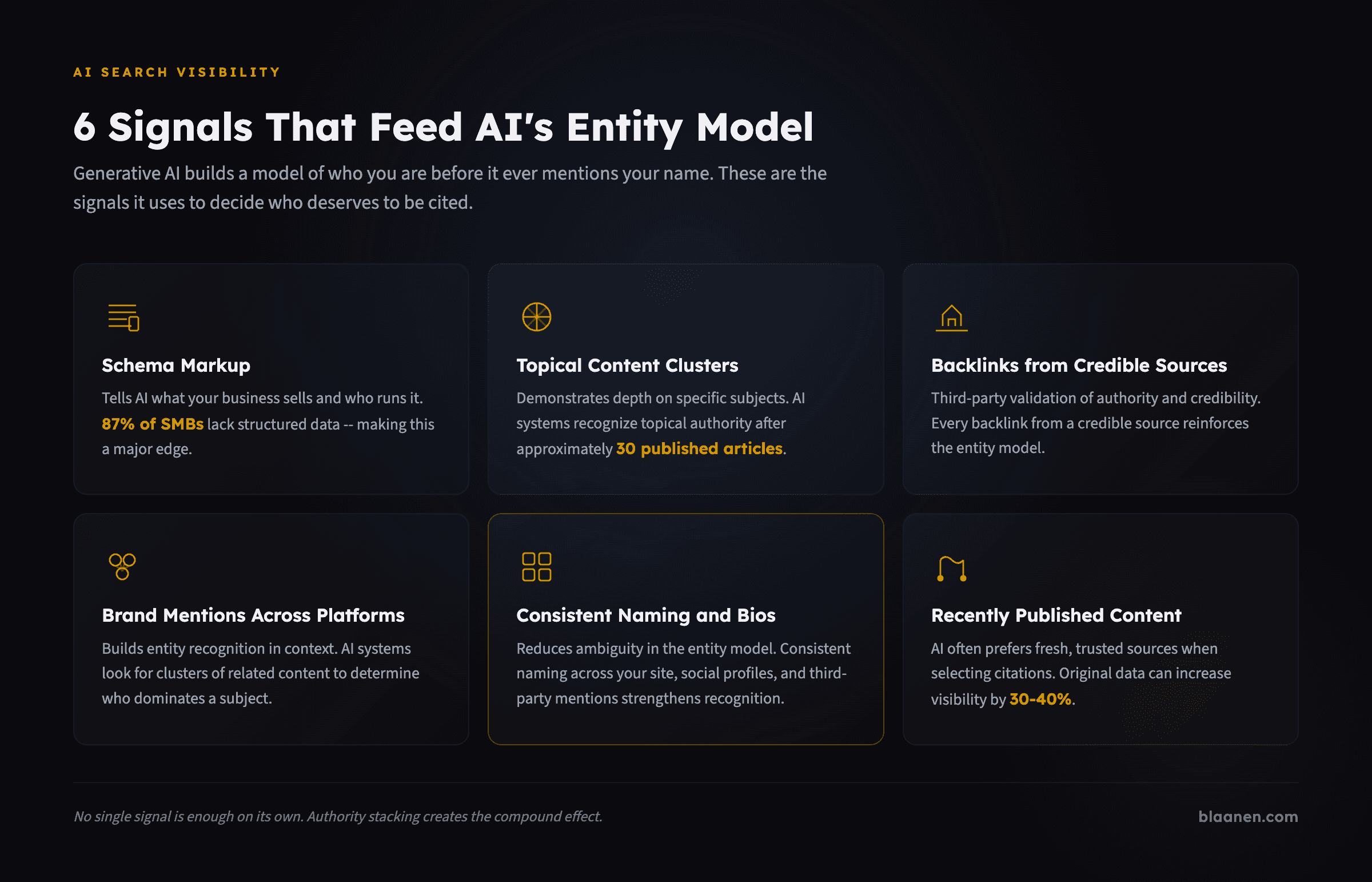
AI assistants evaluate multiple authority signals when selecting citations for AI generated answers. No single signal is enough on its own.
| What is the signal? | How does it contribute to answers about your business? |
|---|---|
| Schema markup | Tells generative AI what your business sells and who runs it |
| Topical content clusters | Demonstrates depth on specific subjects |
| Backlinks from credible sources | Third-party validation of authority and credibility |
| Brand mentions across platforms | Builds entity recognition in context |
| Consistent naming and bios | Reduces ambiguity in the entity model |
| Recently published content | Often prefers fresh trusted sources when selecting citations |
The credibility of your broader presence matters. They evaluate not just your site but the depth of your content and the reputation of your brand across the web.
What Makes Content Citeable for AI Search?
AI search engines extract information using patterns and prefer content that is organized with intention. High quality content that provides direct answers, uses clear structure, and states claims upfront is significantly more likely to be surfaced in AI generated responses. This is the foundation of earning AI citations.
1. Answer-First Structure
When you structure headers as questions with clear answers in the first paragraph, you make it easy for generative AI to extract and cite sources from your content.
This is what citability engineering looks like in practice. The term emerged from SEO research and practitioner experimentation, not from any single person. I apply it as a systematic step in the content pipeline.
Self-contained sections are critical. Each section needs to be understandable on its own because AI assistants parse segments, not full pages. Short paragraphs and scannable formatting increase the chance your content cited by AI gets attributed back to you.
2. Clarity Over Cleverness
Generative AI prefers content that is original, credible, and easy to understand. Clever wordplay or buried conclusions reduce the likelihood of earning citations.
State your claim upfront. Make it verifiable. Use structured content with clear headings so AI search tools can find the specific answers they need.
AI prioritizes unique contributions. Original data or research can increase visibility by 30-40% (Source: Botify, 2024). Content that restates what ten other sites already say will not earn citations from AI assistants.
How Does Google AI Handle Recommendations Differently Than ChatGPT?
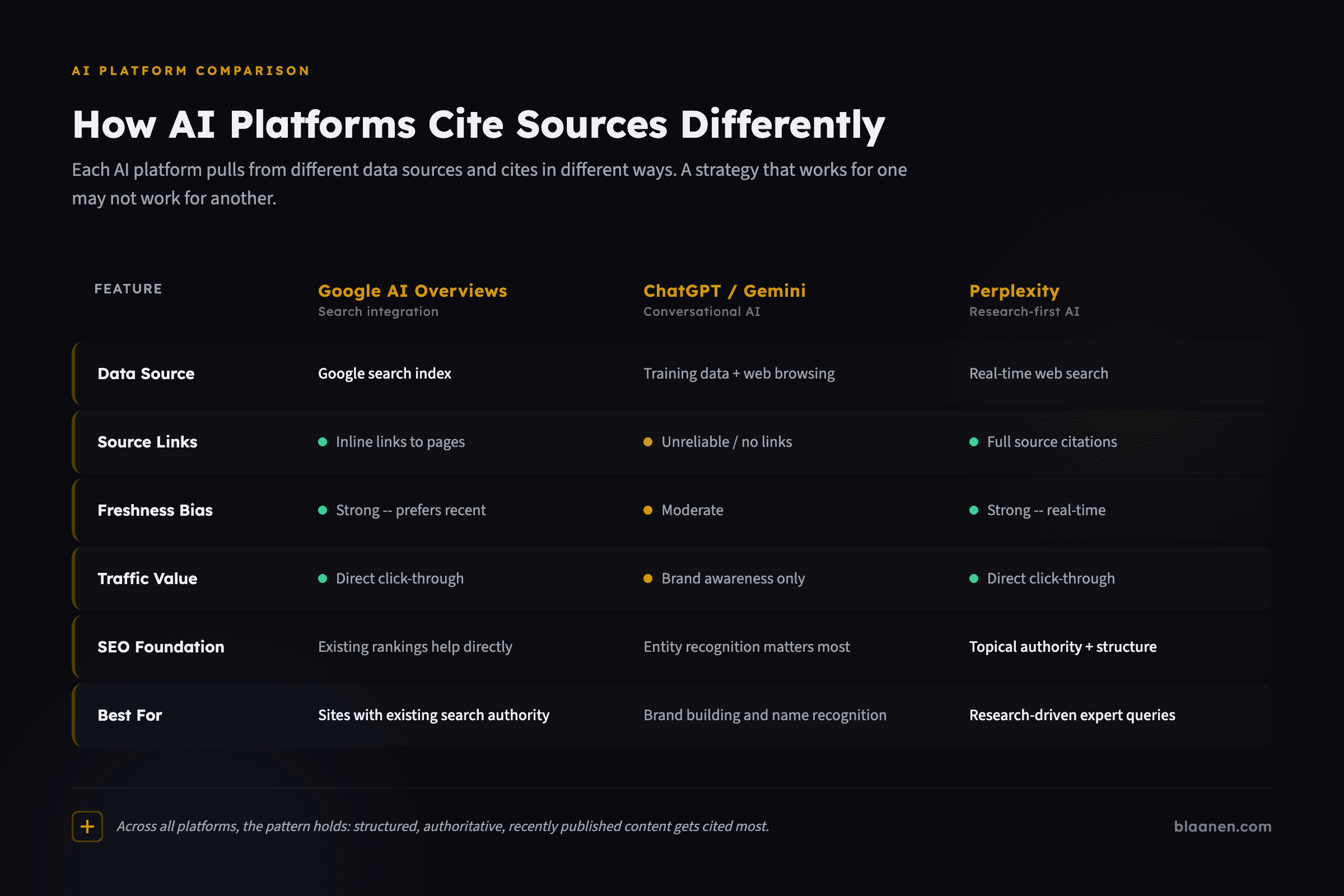
Google AI Overviews, ChatGPT, Perplexity, and Bing Copilot each pull from different data sources and cite in different ways. Understanding these differences is practical because how people find answers varies across platforms. A strategy that works for Google AI Overviews may not produce the same AI results in AI assistants like ChatGPT.
1. Google AI Overviews
Google AI Overviews pull from the indexed web and display inline citations with links to source pages.
They favor recently published content and sites with demonstrated topical authority. If your site ranks well in traditional search results, you already have a foundation for AI Overviews visibility. Google AI Overviews are the most visible generative AI feature in Google search results today.
The connection to traditional search is direct. Google uses its existing search index as the starting point for generating answers.
2. ChatGPT, Perplexity, and Bing Copilot
ChatGPT mentions brands and experts but does not reliably link to source content. At best, someone sees your name and has to search for you separately. Google Gemini behaves similarly in its AI responses.
Perplexity is different. It cites sources with actual links, making it more useful for research-driven queries where users look for specific expertise. For visibility in AI search, Perplexity citations carry more direct traffic value.
Bing Copilot pulls from Bing's search index and provides inline AI citations. Its behavior is closer to Google AI Overviews than to ChatGPT. Across all these AI assistants, the pattern holds: structured, authoritative, recently published content gets cited most. Each page type performs differently depending on the platform.
Why Does Schema Matter for AI Visibility?
Schema markup tells generative AI what your business sells, who runs it, and what credentials back up the content. Without it, your site's harder for ai systems to parse. Implementing it puts you ahead of most competitors immediately because the adoption gap is significant.
1. Schema as Entity Specification
Person schema, Organization schema, Article schema, and FAQ schema each help AI tools interpret your site accurately.
87% of SMB websites lack structured data markup (Source: Schema App, 2024). That means most of your competitors are invisible to generative AI at the technical level. Adding schema is one of the most direct ways to improve your AI visibility.
Technical SEO provides the stability that AI systems need to process your pages. A clean robots.txt, an updated sitemap, and proper markup are the baseline. AI seo strategy for any business starts with these foundations.
2. The Brand Brain Connection
The brand brain is the human-readable entity specification. Schema is its machine-readable translation. When both tell the same story, generative AI has a clear, consistent entity to reference. The brand brain is effectively a human-readable entity specification (the full extraction process).
When your brand brain and your schema align, that consistency builds brand visibility over time. AI assistants can process your business identity accurately because every signal reinforces the same story.
What Does Authority Stacking Look Like in Practice?
No single signal earns AI citations. Authority stacking combines multiple signals into a compound effect where each one reinforces the others. The term is not proprietary. It emerged from SEO research and describes something I apply as a strategic framework for coaching and consulting brands.
1. The Compound Effect
Topical content depth, schema, backlinks, credible mentions, and AI citations together build authority that is hard to displace.
Here is what that looks like with real numbers. John Mattone Global, the #1 executive coaching authority, accumulated 626 AI citations across AI Overviews after building structured content depth and consistent entity signals. That volume did not come from one tactic in isolation. It came from authority stacking in the context of a full strategy: schema, topical clusters, and credible third-party mentions reinforcing each other to earn citations over time.
AI systems recognize topical authority after approximately 30 published articles (the growth curve). Below that threshold, your site lacks the depth for search engines and AI systems to treat it as a definitive source. Consistent updates to your site content signal ongoing authority that generative AI models begin to remember.
2. Cross-Platform Presence
AI systems look for clusters of related content to determine which sites and people dominate certain subjects.
Appearances in industry publications, relevant forums, and niche blogs all contribute to the entity model. These credible mentions across relevant communities build the cross-platform presence that AI systems use to validate your authority.
Brands with high visibility scores are frequently cited because they show up across multiple credible sources. Your own site is the foundation, but AI assistants weigh your broader presence when generating answers about your area of expertise. Every backlink from a credible source reinforces the model.
What Is the Honest Limitation of AI Citation Strategy?
The evidence for AI citation strategy is strong, but individual before-and-after measurement is still limited. I haven't measured the specific impact of schema on AI citations for my own clients in a controlled way. The industry evidence is directional. It points in a clear direction, but guaranteed outcomes don't exist in AI search or traditional search.
AI answers change based on shifting citation behavior. What gets cited today may not get cited next month. The old seo fundamentals still apply: good content, technical foundations, traditional seo best practices, consistency.
What I am confident about is this: the work that positions you for AI citations is the same work that improves your visibility in search overall. E E A T signals (Experience, Expertise, Authoritativeness, Trustworthiness) matter for both AI answers and Google search results. AI traffic and organic search traffic come from the same foundation of credibility and structure.
Doing this work does not guarantee AI citations, but not doing it guarantees AI models will not find you. The gap between businesses with structured visibility strategies and those without is already widening. You can see what that gap looks like on the AI visibility gap page.
How Do You Start Getting Recommended by AI?
Getting recommended starts with becoming a recognizable entity in both traditional and AI seo. That means building the technical foundation, structuring every piece of content for citability, and earning mentions beyond your own site. This is how to get recommended by ai in practical terms.
1. Build the Entity Foundation
Start with technical SEO. Implement schema for your business, your team, and your content. Use consistent naming across every platform where you appear.
Then create content that maps your expertise into topical clusters. Each cluster signals to AI systems that your site is a reliable source on that subject. User intent should guide which topics you cover first.
2. Structure Every Piece for Citability
Use tools like Surfer SEO to target the right NLP terms. Format headers as questions. Open every section with a direct answer.
Make each section self-contained so AI search tools can extract and cite sources independently. Add internal links to your key pages. Unique insights and original perspectives are what separate citeable content from generic articles that get ignored.
3. Earn Mentions Beyond Your Site
Build authority through third-party mentions on credible sites. Contribute to industry specific forums and relevant communities where your audience already looks for answers. Compare options for where to invest your time: podcast appearances, guest posts, related topics where your expertise adds value, and backlinks from respected publications. These are how you earn citations beyond your own site.
Generative AI evaluates the strength of a brand's broader presence. Your site content is the starting point. Your presence across the web is what completes the picture. Dig deeper into any one of these areas and you will find that earning AI citations is not about a single tactic. It is about building a business presence that these tools can confidently cite as a reliable source. The businesses that earn citations consistently are the ones that show up everywhere their audience looks for answers.
Your Expertise Deserves to Be Found
AI search is not replacing traditional search. It's adding a layer where being cited matters as much as being ranked. AI generated answers from search engines and generative AI tools reward clarity, structure, authority, and originality. The businesses that invest in these signals now are the ones AI assistants will recommend when users ask for answers in their field.
The starting point is extracting your real expertise into a format that both humans and machines can understand. That's what the brand brain process does. If you're not sure where your visibility stands today, the visibility gap assessment shows you exactly what AI sees when it looks for your business.
Your expertise is too important to stay hidden from the answers that people rely on. The people searching for what you offer deserve to find you. See how the full process works or reach out directly.
Ready to explore what this looks like for your business?