Chapter 8 of 8
5 min read
The Trust Hierarchy: Why Your Best Clients Find You Through Search
Most coaches pick marketing channels based on cost or reach. But when someone is deciding whether to invest $10K in coaching, they are not comparing prices. They are deciding whether they trust you enough to say yes.
The channel that brought them to you shapes that trust before you ever get on a call. I built a framework for this after watching my own pipeline data and comparing it to what I saw on social media. The difference was striking, and it had nothing to do with effort.
Key Takeaways:
- The Trust Hierarchy ranks five marketing channels by buyer trust for high-ticket services
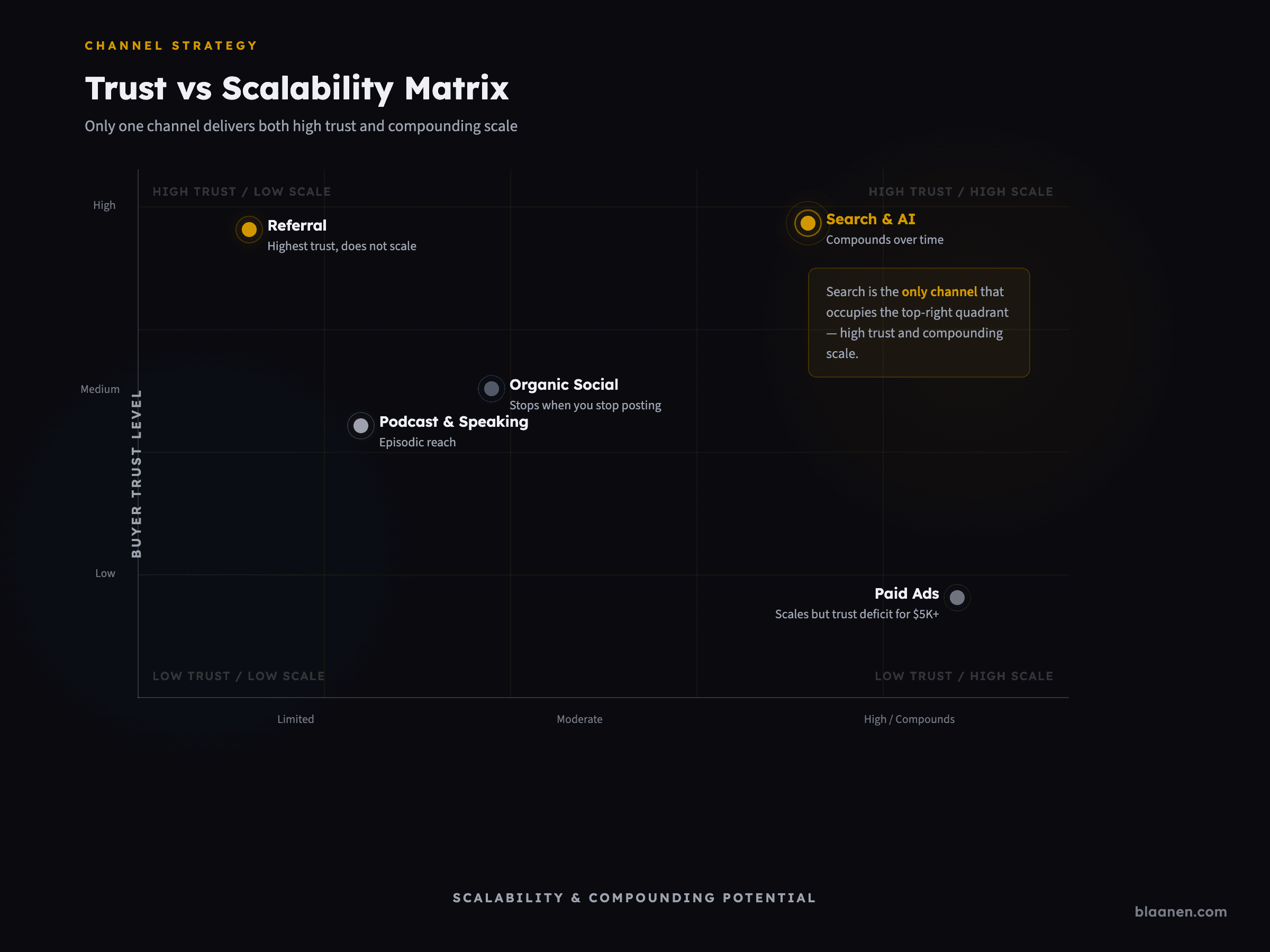
- Search is the only scalable channel in the top three trust positions
- Visitors who find you through search pre-qualify themselves before reaching out
What Is the Trust Hierarchy?
The Trust Hierarchy is a framework that ranks marketing channels by how much trust they generate for high-ticket services above $5,000. It applies specifically to coaching and consulting, where the buyer must trust the provider personally before committing.
The five levels, ranked by buyer trust:
- Personal referral (highest trust, does not scale)
- Self-directed search and AI research (high trust, scales)
- Consistent organic social presence (medium trust, requires constant input)
- Podcast and speaking exposure (medium trust, episodic)
- Paid advertising (lowest trust for high-ticket)
For coaching purchases above $5K, trust determines the sale. No amount of ad spend overcomes a trust deficit when someone is hiring a coach to work on their leadership, their career, or their life.
Why Does Position #2 Matter Most?
Position #2, self-directed search, is the only channel in the top three that scales without your direct involvement. Referrals sit at #1 but they're capped at your existing network. Organic social sits at #3 but requires daily posting to stay visible.
Search works differently. Content you publish today generates leads for years. It compounds while you sleep, while you coach, while you take a week off.
AI-referred visitors convert at significantly higher rates than other channels. Brands cited in AI Overviews earn meaningfully more organic clicks. These trust signals can't be purchased. They can only be earned through depth and consistency.
A Google #1 ranking is an implicit endorsement. An AI citation is an even stronger one. No ad can replicate that credibility.
For the full compounding math, see how SEO ROI works for coaches.
What Is the Self-Qualifying Search Path?
When someone searches for a relevant topic, reads three articles on your site, and reaches out, they have already pre-sold themselves. No nurture sequence made that happen. No sales funnel guided them there.
The search intent itself was the qualification filter. By the time they fill out your contact form, they have already:
- Identified their own problem
- Researched potential solutions
- Evaluated your expertise through your content
- Decided you are worth talking to
Compare that to LinkedIn outreach, where you qualify one conversation at a time. Search does it at scale, 24/7, with zero effort after publication.
This is also why sales readiness matters before investing in SEO. Pre-qualified leads arriving at a broken sales process is the most expensive mistake in SEO.
What About LinkedIn and Social Media?
LinkedIn is valuable for coaches. It builds visibility and opens conversations. But it requires constant input, and the moment you stop posting, the visibility drops.
I experienced something else too. Social media makes comparison easy. You see hundreds of likes on someone else's post and wonder why yours got twelve.
You start measuring your progress against people on year ten of building their platform. The vanity metrics pull your attention away from your own progress.
SEO makes it easier to see the journey you are on. Progress shows up in rankings, traffic, and leads over months. Not in likes compared to a stranger.
This is not anti-social-media. It is pro-diversification. Use LinkedIn. Post when you have something worth saying. But build search as the compounding foundation underneath it all.
What Happens When Referrals Run Out?
Referral dependency means your pipeline disappears the moment your network stops producing introductions. Every coaching business hits this ceiling eventually. The timing is unpredictable, but the pattern is consistent.
You don't want to reach the end of the referral barrel and realize you need to start from scratch. By then, a competitor who started building search visibility six months ago already owns the keywords you need.
The fix is straightforward. Build your search pipeline while referrals are still flowing. Get ahead of the problem instead of reacting to it.
The coaches who diversify early never experience the panic of an empty calendar. They built a second pipeline before the first one dried up.
Does This Work in Practice?
John Mattone Global provides the clearest example of the Trust Hierarchy in action. One client's organic search traffic grew 4.4x and became the primary source of new business (the full case study).
This pattern repeats across coaching clients I have worked with. Rebecca Campbell's site still drives 2.7x the traffic it had before the engagement, even 1.5 years after active production stopped. That is what compounding looks like in practice. When coaches invest in building their search presence with real IP and consistent publishing, search becomes the dominant lead source within twelve to eighteen months. Not because referrals stop working, but because search scales in ways referrals can't.
Where Should You Start?
The Trust Hierarchy isn't about abandoning any channel. Referrals will always matter. Social media has its place. Podcasts build credibility.
But search is the only channel that scales, compounds, and delivers high-trust visitors at the same time. If you are a coach or consultant selling packages above $5K, the question isn't whether search works for high-ticket services. The question is how long you can afford to leave position #2 empty while competitors fill it.
The right people are searching for the help you provide right now. Whether they find you or someone else depends on what you build today.
Ready to explore what this looks like for your business?