Chapter 1 of 8
5 min read
The Brand Brain: How We Capture What Makes You Different
Most SEO agencies skip the hardest part of content production. They ask a few questions on a kickoff call, review your website, and start writing. The content hits the right keywords. It sounds like it could be about any coach or consultant in your field.
That's not a content problem. It's an extraction problem. The agency never captured what makes you worth reading.
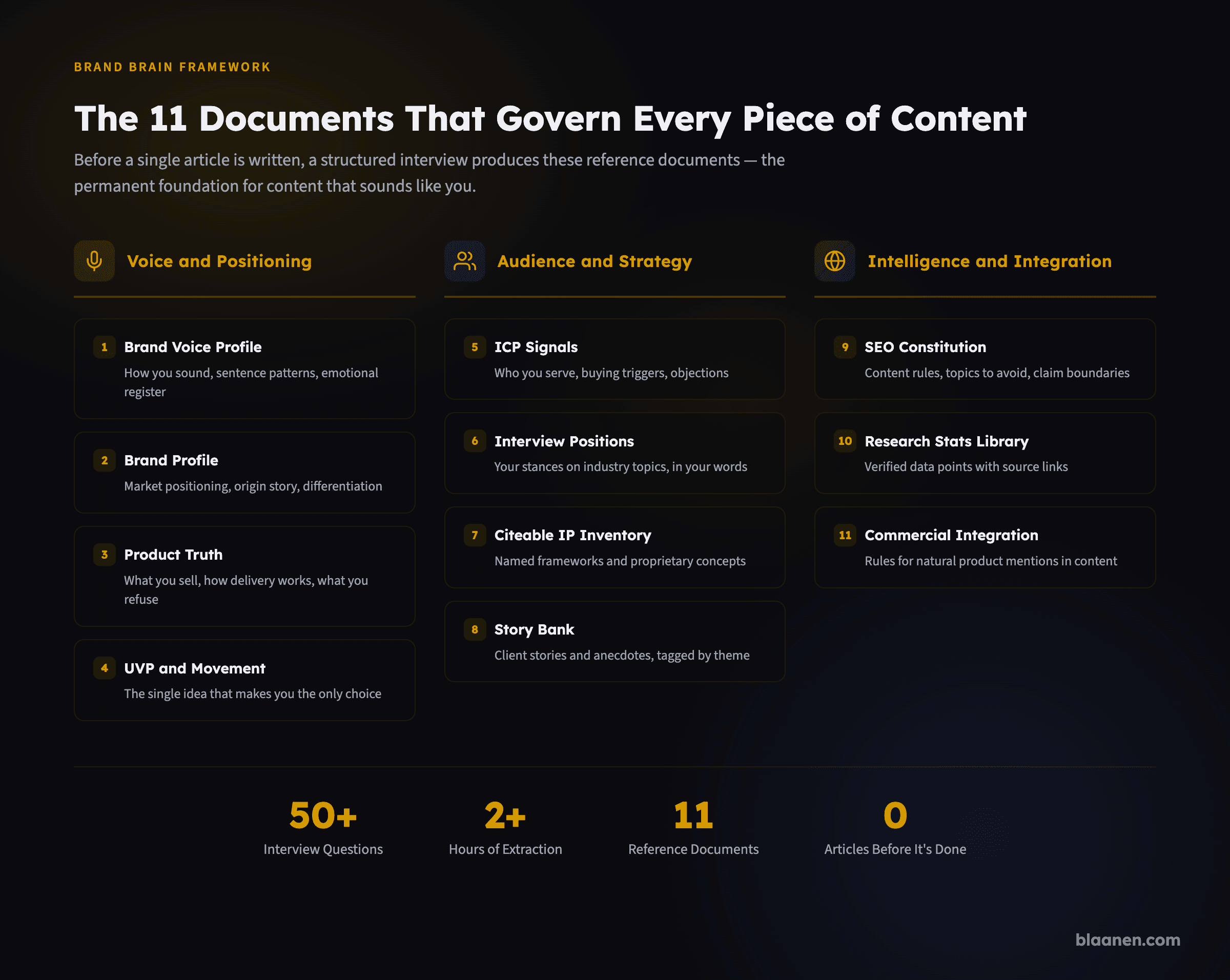
The brand brain extraction process exists to prevent that. Before a single article is written, a structured interview captures what makes you different: your frameworks, your stories, your language, your stances. The result is 11 reference documents that govern every piece of content produced.
Key Takeaways:
- A 50+ question interview (2+ hours) captures your intellectual property, voice, and real experience
- 11 brand brain documents become the governing reference for all content production
- Coaching interview techniques surface perspectives you did not know you had
- No content gets produced until the brand brain is complete
What Is the Brand Brain?
The brand brain extraction process is a structured interview and analysis method that captures a coach's intellectual property, voice patterns, client stories, and transformation frameworks into reference documents. These documents become the foundation for every article, page, and asset produced.
The interview isn't a questionnaire. It runs 50+ questions over two or more hours, conducted live or via voice-to-text. The questions go past surface-level positioning into the beliefs, stories, and language patterns that make a practitioner's perspective distinct.
This depth comes from a specific background. A coaching-trained interviewer asks different questions than a marketing intake form. That training surfaces what someone actually thinks, not what they think they should say.
No content gets produced until the brand brain is complete. Every article, every page, every social post references these documents as governing context.
What Documents Does the Brand Brain Produce?
The brand brain produces 11 reference documents, each capturing a different dimension of a client's expertise, voice, and market position. Together, they give any writer or content system enough context to produce work that sounds like the client.
Voice and Positioning
- Brand voice profile: How they sound, what they never say, sentence patterns, emotional register
- Brand profile: Market positioning, origin story, competitive differentiation
- Product truth: What they sell, how delivery works, what they refuse to offer
- UVP and movement statement: The single idea that makes them the only choice in their category
Audience and Strategy
- ICP signals: Who they serve, buying triggers, objections, deal-breakers
- Interview positions: Stances on industry topics, extracted from the interview in their words
- Citeable IP inventory: Named frameworks, proprietary concepts, and honest attribution for what they coined versus what they apply
- Story bank: Real client stories, career moments, teaching anecdotes, each tagged with theme and usage context
Intelligence and Integration
- SEO constitution: Content rules specific to the brand, including topics to avoid and claims that can or cannot be made
- Research stats library: Verified data points with source links, so articles never rely on fabricated statistics
- Commercial integration guide: Rules for how products and services appear in content naturally, without sounding promotional
Why Does a Coaching Background Make This Interview Different?
A coaching-trained interviewer asks different questions than a marketing agency intake form. The difference isn't technique alone. It's what the technique is designed to surface.
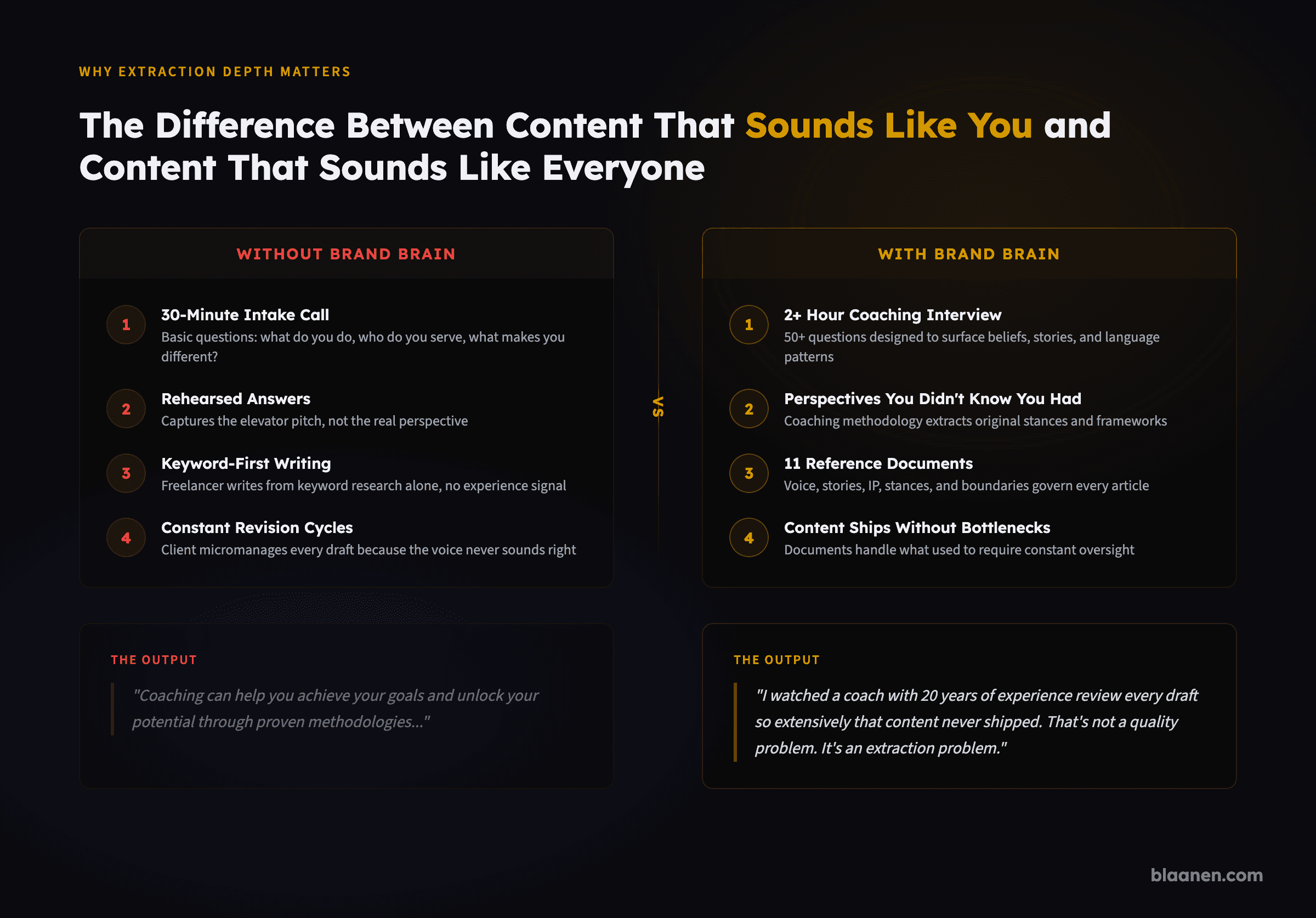
A standard agency onboarding asks: what do you do, who do you serve, what makes you different? These questions produce rehearsed answers. They capture the elevator pitch, not the real perspective.
A coaching-informed interview asks: what do you believe about this topic that nobody else in your field would say? What story from your practice changed how you think about your work?
These questions surface beliefs, language patterns, and stories the client did not know they had. Even coaches without a strong sense of their own IP walk away surprised by what the interview extracts.
The practical outcome: content built on real perspectives, not recycled talking points.
What Happens When the Brand Brain Is Missing?
Without a brand brain, content defaults to generic coverage of a topic. It reads correctly. It targets the right keywords. It sounds like it could be about anyone.
I have seen coaches block their own growth by micromanaging every post. The brand brain solves this upfront (why publishing pace matters).
The brand brain solves this at the source. By capturing everything upfront (voice, stances, stories, frameworks, boundaries), the client doesn't need to micromanage every article. The reference documents handle what used to require constant oversight.
How Does the Brand Brain Connect to E-E-A-T?
Google's E-E-A-T framework rewards content that demonstrates real, lived experience. The brand brain is the extraction mechanism that makes this possible at scale.
Real E-E-A-T means inserting stories the coach has actually lived. It means referencing frameworks they built from direct practice. The brand brain grounds content in years of real client work.
Generic content can't do this. A freelancer writing from keyword research alone produces content without any real experience signal. Google's systems and AI platforms like Perplexity increasingly distinguish between these two types of content.
The brand brain interview surfaces exactly what E-E-A-T requires: specific stories, original frameworks, and practitioner knowledge no competitor can replicate. When AI systems select sources to cite, they favor specificity and experience over generic coverage.
What Does a Brand Brain Document Look Like?
Each brand brain document follows a consistent structure designed for repeated reference. The format ensures any content producer, human or AI, can use the documents correctly.
Here is a simplified example from a story bank entry:
Story: The Revision Bottleneck
Theme: Content velocity, authority building
When to use: Articles about content strategy, the 30-40 post threshold, overcoming perfectionism
The story: A coach with 20+ years of experience reviewed every draft so extensively that content never shipped. The brand brain captured their voice upfront, reducing revision rounds from five to one.
Usage count: Tracked to prevent overuse
Every document includes context for when to use it, the extracted content, and guidelines that prevent misapplication. The documents are living references, updated as the client's business evolves.
For a complete view of how the brand brain fits into the full content production process, the how-it-works page walks through all five phases.
The Brand Brain Is Not a Questionnaire
The difference between content that sounds like a coach and content that sounds like an agency wrote it comes down to extraction depth. A 30-minute intake call can't capture what makes someone's perspective worth reading. A 50+ question interview, built on coaching methodology, can.
The brand brain produces 11 documents that become the permanent reference for all content. Voice, stories, frameworks, stances, audience signals, commercial boundaries. Everything a content system needs to produce work that carries the client's real expertise.
If you're evaluating whether this approach fits your practice, the qualification page covers the prerequisites. For coaches wondering how SEO fits their business model, that page covers the fundamentals. The brand brain is where every client engagement begins. When you're ready, reach out directly.
Ready to explore what this looks like for your business?